Category: Blog

  • Christmas is just around the corner.

    Christmas is just around the corner.

    I hope you’re having a good time.

    As we’re rushing towards Christmas, here in Vienna the days are not only dull and gray and wet, these are also the darkest days of the year. But only for one more week. After the shortest day next Sunday, after the Winter solstice, the days will be getting longer again.

    To make things a bit festive for the holidays, as my little Christmas gift for you, here is a simple but beautiful fingerstyle arrangement of Silent Night.

    You can download the transcription in standard notation and tablature, along with the generated audio file, here:
    https://drive.google.com/file/d/1wl2ufMx5c16NfZRHKyxW8XVn3YalyFfR/view?usp=sharing​

    If you’re unfamiliar with fingerstyle arrangements, it’s basically the guitar acting as a little orchestra: playing the melody and the accompaniment at the same time. Usually, the thumb of the picking hand plays the bass notes (all the notes with stems pointing down) while the other fingers play the melody (stems pointing up). At the beginning, practice the bass and melody parts individually, and then put them back together.

    Happy practicing!

    PS – Short commercial break:

    If you’re still looking for a Christmas gift for a fellow guitar player, or even for yourself, please check out my book on how to understand rhythm on guitar, “TCHA-KA TCHA – Understand and Master Rhythm on Guitar through Vocalizing.”

    Click here to get it now!​

  • Fresh from the press: “The Anthology of Baroque Violin for Guitar”

    Fresh from the press: “The Anthology of Baroque Violin for Guitar”

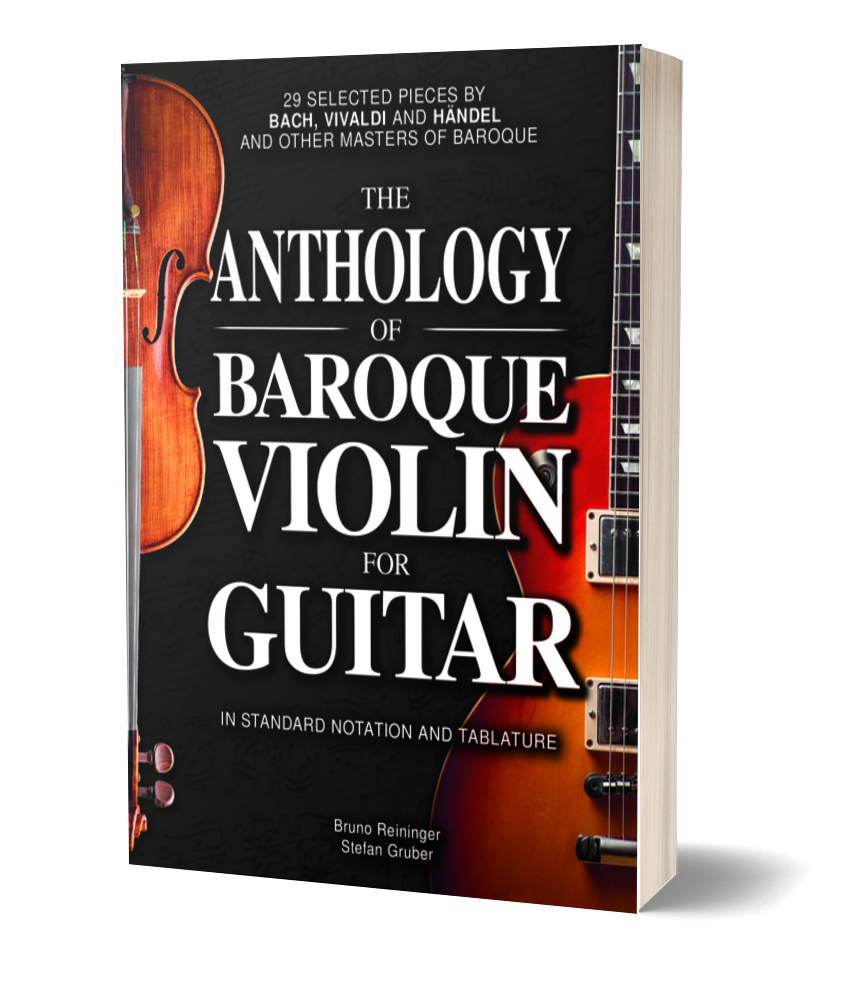
    I’ve just published my new book “THE ANTHOLOGY OF BAROQUE VIOLIN FOR GUITAR: 29 Selected Pieces by Bach, Vivaldi, and Handel, and other Masters of Baroque in Standard Notation and Tablature”.

    Whether you’re a beginner, an intermediate guitarist, or even a seasoned pro, THE ANTHOLOGY OF BAROQUE VIOLIN FOR GUITAR will help you take your guitar playing to the next level. With scalable difficulty, the 29 carefully selected pieces by Baroque masters, including BACH, VIVALDI, TELEMANN, HANDEL, and others, maintain high musical quality while keeping technical demands achievable at a slower tempo.

    Inside THE ANTHOLOGY OF BAROQUE VIOLIN FOR GUITAR, you’ll find:

    • 29 selected baroque violin pieces
    • Transcribed for guitar in standard notation and tablature
    • Works by the great four: Bach, Vivaldi, Telemann, and Handel
    • Works by lesser-know Baroque masters: Aubert, Torelli, Albinoni, Fiocco, and Brescianello
    • Downloadable MIDI-generated audio files of every piece

    Get your copy of “The Anthology of Baroque Violin for Guitar” in the Amazon shop of your preference now:

    ​Amazon US: https://www.amazon.com/dp/3950550232
    Amazon UK: https://www.amazon.co.uk/dp/3950550232​
    Amazon Deutschland: https://www.amazon.de/dp/3950550232​
    Amazon France: https://www.amazon.fr/dp/3950550232​
    Amazon España: https://www.amazon.es/dp/3950550232​
    Amazon Italia: https://www.amazon.it/dp/3950550232​
    Amazon Nederland: https://www.amazon.nl/dp/3950550232
    Amazon Polska: https://www.amazon.pl/dp/3950550232​
    Amazon Sverige: https://www.amazon.se/dp/3950550232​
    Amazon Belgium: https://www.amazon.com.be/dp/3950550232​
    Amazon Ireland: https://www.amazon.ie/dp/3950550232​
    Amazon Japan: https://www.amazon.co.jp/dp/3950550232
    Amazon Canada: https://www.amazon.ca/dp/3950550232
    Amazon Australia: https://www.amazon.com.au/dp/3950550232

    As always, MIDI-generated audio files of all pieces are included for download.

    Enjoy!

  • Consistency > Motivation

    Consistency > Motivation

    I’ve heard so many times, “It’s so hard to practice, often I just don’t feel like it. How can I keep motivated?”

    And they’re right. Especially now that the days are getting shorter and grey, it’s sometimes hard to find motivation. But IMHO we don’t need any motivation. All we need is consistency.

    Motivation comes and goes. And some days I don’t feel motivated at all. That’s why I’m trying not to rely on it.

    I just stick to the plan. I just “show up”, sit down, and practice what’s on my list. If I feel motivated, that’s awesome. But if I’m not motivated, it doesn’t matter. I just stick to the plan. I know that I will benefit. I know that i will enjoy it somehow. I know it will enable me to play the things I love.

    If you can make it a habit (through consistency), you don’t need any motivation at all!

    It’s ok if you don’t feel motivated to practice guitar, just do it anyway! Preferably at the same time every day.

    But that’s enough ranting for today *ggg*

    Here’s another gem from my upcoming book, The Anthology of Baroque Violin for Guitar. This is the 1st movement Allegro of Vivaldi’s Concerto for Strings in D minor, RV 127.

    You can download the transcription in standard notation and tablature, along with the audio files, here:
    https://drive.google.com/file/d/1zw6USQdUAr9QnFJfuTTI-aKXgt_mnfx2/view?usp=sharing

    Happy practicing!

    PS – Have you checked my latest book, “TCHA-KA TCHA – Understand and Master Rhythm on Guitar through Vocalizing”? It’s a proven method that has helped hundreds of my students finally make rhythm easy. ​Click here to check it out​!

  • Back in the Groove & have you heard of Telemann?

    I’m back from Southern Italy, and boy I had needed this vacation!

    We had rented a renovated, hundreds-year-old stone farmhouse in an olive grove. Very simple, the only luxuries being a nice swimming pool, a fridge, and a Bialetti coffee maker. It was wonderful. It’s incredible how little you actually need to be happy.

    So here I’m back in autumnal Vienna, with recharged batteries, and full of good ideas. And the solution to get rid of all the clutter in my house 😀

    At the moment I’m working on an Anthology of Baroque Violin for Guitar together with a friend, and I love all the great music I’m allowed to discover.

    For example, have you heard of Georg Philipp Telemann?

    Georg Philipp Telemann (1681-1767) was considered the best German composer of the time, even better than his friends Friedrich Haendel and Johann Sebastian Bach. He was particularly close friends with Bach, who made Telemann the godfather and namesake of his son; Telemann on the other side often sent commissioned works that he did not want to do himself to Bach.

    Apart from two piano lessons, Telemann was completely self-taught, and wrote more than 3600 composition, making him one of the most prolific composers of all time. He later fell into obscurity, partly because allegedly Beethoven preferred Bach and repeatedly bad-mouthed Telemann.

    Here is the 1. Movement Adagio/Allegro of Telemann’s Violin Concerto in D major, TWV 51:D10

    You can download the transcription in standard notation and tablature, along with the audio files, here:
    https://drive.google.com/file/d/1YtVSMUguXWkTTZ1qDO5zzyONAt48TAY6/view?usp=sharing

    Happy practicing!

  • We’re already halfway through summer, let’s play some Vivaldi

    It’s hard to believe that we’re already halfway through summer. I hope you’re finding time to enjoy these warm days while they last.

    After the launch of TCHA-KA TCHA things have settled down a bit, and I want to thank everyone for the fantastic feedback I’ve received so far!

    Now I’m enjoying the summer. Here in Vienna, July was unusually cool – actually, it was more like a typical July from the past :D. It’s been really nice not to have to run the air conditioning at full blast all the time. And sitting outside in the evening with a light sweater on is actually kind of cozy.

    For my next project, I’m working with a friend and mentor to transcribe famous Baroque violin pieces for the guitar.

    Here, for example, is the 3rd movement, Allegro, from Antonio Vivaldi’s Concerto for Strings in C minor, RV118.
    Download the PDF with the score in standard notation and tablature, along with the MIDI-generated audio files, here:
    https://drive.google.com/file/d/1QmvVTtM5hkfD3sgp-fXYzXzu6Y4H5qOI/view?usp=sharing​

    Happy practicing!

  • It’s here! “TCHA-KA TCHA” is now available

    It’s here! “TCHA-KA TCHA” is now available

    The wait is over!

    It’s finally here! After more than ten years of thinking about this book, and over a year of writing it, it is finally here! “TCHA-KA TCHA – Understand and Master Rhythm on Guitar through Vocalizing” is officially available today.

    This isn’t just another guitar method book. It’s a proven system that might transform your approach to rhythm forever.

    What’s inside:

    • How to “hear” patterns before you play them, so you learn faster and better
    • 481 drills with downloadable audio files to increase your skills and self-assurance
    • Techniques to build groove through your voice and body, and access your inner flow
    • The secrets behind accents, syncopation, and swing that lead to upbeat performance
    • Tips for strengthening timing and tone, and much, much more!

    Get your copy of “TCHA-KA TCHA – Learn and Master Rhythm on Guitar through Vocalizing” in the Amazon shop of your preference:

    ​​Amazon US: https://www.amazon.com/dp/3950550216​
    Amazon UK: https://www.amazon.co.uk/dp/3950550216
    Amazon Deutschland: https://www.amazon.de/dp/3950550216
    Amazon France: https://www.amazon.fr/dp/3950550216​
    Amazon Espana: https://www.amazon.es/dp/3950550216​
    Amazon Italia: https://www.amazon.it/dp/3950550216
    Amazon Nederland: https://www.amazon.nl/dp/3950550216​
    Amazon Polska: https://www.amazon.pl/dp/3950550216
    Amazon Sverige: https://www.amazon.se/dp/3950550216
    Amazon Japan: https://www.amazon.co.jp/dp/3950550216​
    Amazon Canada: https://www.amazon.ca/dp/3950550216​
    Amazon Australia: https://www.amazon.com.au/dp/3950550216​

    Enjoy!

  • The surprising approach that transformed my guitar playing (and may transform yours too)

    What if I told you that the key to mastering rhythm guitar isn’t in your fingers… It’s in your voice?

    I know it sounds strange.

    Rhythm had always been challenging for me. It wasn’t the act of singing, dancing, or playing rhythmically that posed the problem, but rather understanding how rhythm works, how it is notated, and how to read it. This was very frustrating for me, and I had the feeling it was holding me back in my development as a musician.

    The breakthrough came when my teacher introduced me to vocalizing rhythm while working through “Modern Reading Text in 4/4” by Louis Bellson.

    Not just counting “1-2-3-4” but actually saying rhythmic patterns out loud using syllables like “TCHA-KA TCHA.”

    Each week, we sang and clapped through one page, and soon, everything clicked. Rhythm started to make sense to me – it became easy.

    Since then, I have used vocalizing for years while teaching my students, and the results were incredible. Students who had been stuck for months suddenly “got it.” Their timing improved, their confidence soared, and playing rhythms became easy.

    That’s why I’ve spent the last year putting together everything I’ve learned into a comprehensive textbook: “TCHA-KA TCHA – Understand and Master Rhythm on Guitar through Vocalizing.”

    Over the next few weeks, I’ll be sharing more about this awesome approach and how it might help your playing. Stay tuned for some eye-opening insights about rhythm that may transform your playing.

  • Good Things Take Time

    I just realized it’s been over a year since I wrote my last post. Perhaps you can relate to this situation: you miss a deadline and feel bad about it, then you miss another one, and before you know it, you start to forget about it—or rather, repress it. It’s funny because I genuinely enjoy writing these posts and reading and responding to the replies.

    Anyway, I promise to do better in the future! 😀

    ​As a little gift, I’ve transcribed the third movement, Allegro, of Antonio Vivaldi’s Violin Concerto in Bb major RV 381 for you. Written around 1710, it’s a lovely piece in 12/8, played mainly in the first and third positions.

    Download the PDF with the score in standard notation and tablature, along with the MIDI-generated audio files, here:
    ​https://drive.google.com/file/d/1bJkc4T7hDDq3TxiKCpy0hFI3IrY2TkPf/view?usp=sharing​


    Over the past year, I have been busy writing my new book on how to understand rhythm on guitar through vocalizing. The writing is done, the cover and artwork are in the works, and I’m almost finished recording all 481 audio examples.

    If the stars align and everything goes smoothly, I hope to publish it by the end of this month!

    Happy practicing!

  • Happy Easter

    Spring’s in full swing, and this morning, I even found a chocolate bunny in my garden.

    This time, I have a nice little musical piece to share with you.

    It’s one of Niccolo Paganini’s 43 Ghiribizzi (also known as fantasies) for guitar.

    Niccolo Paganini (1782-1840) was not only a famous virtuoso violinist but also ano utstanding guitarist and composer of numerous works for guitar.

    ​You can download the PDF with the score in standard notation and tablature, along with the MIDI-generated audio files, from the link below:
    https://drive.google.com/file/d/1xmXan7wvJBaxVpMuwZykZodmDxEvF6cA/view?usp=sharing

    Happy practicing!

  • How to practice effectively

    How to practice effectively

    Through practice, we can improve and perfect any movement, whether it’s walking, cycling, crocheting, tennis, or playing an instrument.

    But how does it actually work?

    In the wonderful TED-Ed video “How to practice effectively… for just about anyting” Annie Bosler and Don Greene illustrate the principles of effective practicing. We learn about the plasticity of the brain* and how myelin builds our neural pathways into super-efficient data highways.

    *) Neuronal plasticity is the ability of synapses, nerve cells or even entire brain areas to change their anatomy and function in order to optimize ongoing processes. Depending on the system in question, this is called synaptic plasticity or cortical plasticity, for example.

    They describe how to practice effectively and how to “master” a movement through thousands of conscious, slow, and controlled repetitions.

    Mastering any physical skill takes practice. Practice is the repetition of an action with the goal of improvement, and it helps us perform with more ease, speed, and confidence.

    Have fun upgrading your brain!